Blogs become books. Can a memoir become a sitcom?

Moving to the other side of the cash wrap…felt as disorienting to me as Alice might have felt when she slipped through the mirror into Wonderland, landing unawares in…a world populated by Mad Hatters, rushing rabbits, chatty chess pieces, and enormous mushrooms. ~ Caitlin Kelly in MALLED

Behind the scenes. That’s where Caitlin Kelly takes readers in her memoir Malled: My Unintentional Career in Retail (out April 14, 2011 from Portfolio). Today, I’m hosting Caitlin here to talk about her journey from an essay in the New York Times, to a memoir, to contract talks with CBS.

From Caitlin’s bio:

The book combines her personal story of moving into low-wage customer service at 50; others, mid-career and mid-recession, taking these jobs and a detailed, national analysis of this $4 trillion industry.

A regular contributor to The New York Times since 1990, Kelly has written for USA Today, The Wall Street Journal, Washington Post, Glamour, More, and other publications in Canada and Europe. A former reporter for the New York Daily News, Toronto Globe and Mail and Montreal Gazette, she is the winner of a Canadian National Magazine Award (humor), and five journalism fellowships. Born and raised in Canada, she has lived in the U.S. since 1988, and has also lived in England, France and Mexico.

As a bonus, Caitlin is giving away a signed copy of her memoir. At the end of her guest post, leave a comment to be entered into the drawing for a copy of Malled. Random.org will choose the winner on Tuesday, September 6th, at high noon.

 Welcome, Caitlin Kelly

If you’d told me that taking a low-wage job folding T-shirts in a suburban mall would lead to negotiating a contract with CBS on my birthday for a possible sitcom based on my life, I’d have laughed hysterically.

But that’s exactly what’s happened to me since Sept. 25, 2007 when I was hired to work as a part-time sales associate for The North Face at an upscale mall in White Plains, NY. I hadn’t worked a low-wage job since high school, was 50 and heading into a recession.

My own story quickly became just one of many in this ongoing recession. In February 2009, I published an essay in The New York Times business section explaining how moving from journalism – my only industry since graduating college in 1979 – to retail had turned out, then, to be a good choice for me. I liked the clarity of retail’s reported numbers: how much I sold per hour, my average daily sale, what percentage of my merchandise was later returned. In journalism, publishing and blogging, all judgments of value are totally subjective.

By June 2009, I had found an agent who felt confident we could find a publisher to take my memoir of working in the nation’s third-largest industry and single greatest source of new jobs. It wasn’t quite as quick and easy as we’d hoped, with 25 rejections before Portfolio, the business imprint of Penguin, bought it in September 2009.

I continued working in the store for another three months, taking many more notes than before, gathering as much detail, color, anecdote and dialogue as possible. No one at the company knew I was writing a book, and it felt strange to be writing things down while standing at the cash wrap.

I quit the job December 18, 2009 and began to write full-time. By June I was done, although revisions and some restructuring were necessary. Because retail is ever-changing, I read the business press every day, adding as necessary to keep the manuscript timely and up-to-date.

“Malled: My Unintentional Career in Retail” was published April 14, 2011 and received a terrific amount of national attention, with reviews and features in People, Marie-Claire, USA Today, The New York Times, Financial Times and Entertainment Weekly. I also appeared on NPR’s Diane Rehm Show (2 million listeners), Marketplace and The Brian Lehrer Show.

Emails soon started showing up from major entertainment companies expressing interest in it as a vehicle for film or television. I thought they were hoaxes! But by June 6, 2011, my birthday, we had an offer from CBS to option “Malled” as a possible sitcom. They have since commissioned a script. The next steps, I hope, are a pilot and a series; if so, I’m signed on as a story consultant for a few years.

This fairly quick journey from a Times essay to a book to a possible television show is a combination of factors: timing, luck, story, competition, voice and a tough agent. There have only been three other books I’m aware of now on the market that really describe in real time what it’s like to lose a good job, move down the economic ladder and tell the truth about how it feels. I was fortunate enough to find a good agent and an enthusiastic publisher. The book is written as a memoir, but it’s not just my story. I knew from the start that my story alone was insufficient, so it also includes dozens of original interviews with other sales associates nationwide, senior retail executives, Wall Street analysts and others.

One way I managed to get the book produced fairly quickly was – as I also did with my first book, “Blown Away: American Women and Guns” – by hiring researchers. They conducted some of my interviews and gathered statistics.

In the past few weeks, I’ve spoken as the closing keynote at a retail conference in Minneapolis, celebrated the sale of “Malled” to China, where it will be translated, and chatted with the veteran screenwriter who’s now creating his characters, one of them based on me.

It’s all a little surreal, kind of exciting and a lot more fun than folding T-shirts.

~

Entertainment Weekly calls [Malled] “an excellent memoir” and USA Today says “Malled is a bargain, even at full price. Kelly is a first-rate researcher and storyteller.” Original interviews include consultant Paco Underhill, retailer Jack Mitchell and Costco CFO Richard Galanti.

Read more on Caitlin Kelly by visiting her website and her blog, Also, check out another book by Kelly, Blown Away, on American women and guns. Don’t forget to leave a comment, as well, for a chance to win a copy of her memoir.

Sunday Discoveries

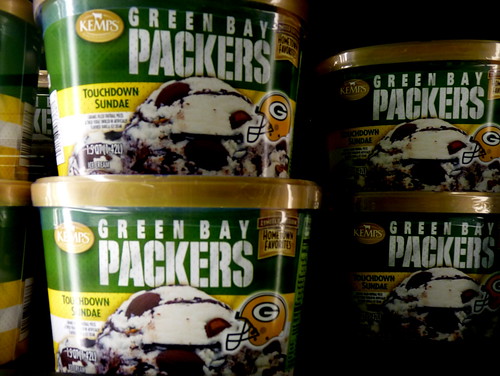
Found, in the freezer at our local grocery store:

Packer Country

Kemps Touchdown Sundae. Vanilla ice cream with a hint of fudge swirl and small treasures of chocolate footballs (complete with a caramel filling). It’s egg-free, nut-free, but not sugar-free, and it’s perfect for a rambunctious about-to-be-a-fourth-grader boy who’s trying to “beef up” for the school year.

Found, in my local library:

A Memoir after my own heart. Because reading food labels, on everything from ice cream to bread, is more about bypassing a trip to the ER than counting calories for me.

If you stand in the middle of the grocery aisle and study ingredients, or if the mention of a “pot luck dinner” makes you break out into a cold sweat, read this book. Sandra Beasley’s memoir touches on every aspect of food allergies, from the perspective of the allergic, those who care for someone with allergies, and even the research and science behind allergies.  I can’t say enough about how much I love, LOVE, this book. I have it on loan right now, but I want a copy for myself. I want to slip it onto my son’s nightstand in a few more years, when he’s too big for me to check his pockets for his Epi-Pen.

Found, in my schedule for fall:

Not enough time (27/365)Time. I was glad (ever-so-slightly) last Monday when my day job kicked in, and not just because my mornings and evenings became more predictable. As I considered my start and end times and my work schedule unfolded, my day planner revealed a secret: little pockets of time to myself each day. The impossibility of it all was matched with a dose of guilt, so I closed my calendar quick. Afraid to breathe. Maybe that sounds dramatic, but if you’re a mother and a writer, you know the value of any uninterrupted time (and the power in a second of guilt).

Free time is there, though. I’ve double checked.

Found, on Writer Unboxed:

Twitter Bird SketchTwo great posts by Nina Badzin on the Art and Science of Twitter, Part 1 and Part 2.

If you’re new to Twitter, and even if you’re not new, these posts are a must-read. Because when you suddenly discover a pocket of time, you don’t want to waste it on Social Networking. Nina Badzin explains how to make Twitter work for you, so that you can get back to work, doing what you love best.

What’s new in your kitchen, on your shelves, or in your reader?

Welcome Jenna Blum, Bestselling Author of The Stormchasers

Go get him, Karena, he said. You’re the only one who can.

And Karena knew this to be true, from the nights she was the only one who could sing Charles to sleep, the only one who could coax him off the roof, keep him from climbing the water tower, make him stop chanting that song, stop bouncing that ball, stop kicking that door. She ran out into the lot, tasting the dirt in the air, positioning herself…where Charles would either have to stop or run her down….
~ from The Stormchasers

More than once, I’ve fallen victim to the belief that I could save someone: a friend in despair, a parent on the brink, a loved one chasing a false god down a dark road. I’ve set my voice on an uncomfortable high note in hopes that enthusiasm was contagious, played counselor during marathon phone calls,  stood in the way of the inevitable and gotten pinched in the middle. Painful lessons are never pretty.

But in Jenna Blum’s amazing novel, The Stormchasers, we find a story that mixes the agony of mental illness with the beauty of landscape, the power of devotion, and the miracle of unexpected healing. A novel as much about mental illness as it is about storms, The Stormchasers gives readers vivid images of how both phenomena mirror each other in the way danger brews and crescendos, then crashes and leaves a path of destruction.

The main character, Karena Jorge, is driven in her work as a journalist and in her search to save her twin brother, Charles, from himself. She sets out on a stormchasing expedition, one that puts her in danger at times and brings her closer to a different discovery: Charles is not the only one who needs saving.

The Stormchasers, touching and poignant, is a story that I will read again. I’m so honored to host Jenna Blum today for an interview about her novel, about writing, and about karma. At the end of the interview, leave a quick comment to be entered into the drawing for a copy of The Stormchasers. Random.org will choose the winner on Tuesday, August 30th, at high noon.

**UPDATE: Because of Irene’s visit to the East Coast, and subsequent power outages over the weekend, I’m going to postpone the drawing for a copy of Jenna Blum’s novel until Thursday, Sept. 1st.**

CC: In a recent and compelling essay on the website, Style Substance Soul, you talk about a childhood fascination with tornadoes and reasons why you chase storms (even after the novel has been published). Did the idea for THE STORMCHASERS stem from your personal experience on the road with Tempest Tours, or was it your research with them that took root and sealed your strong connection with the chasing community?

JB: That’s a great question! I had the idea for THE STORMCHASERS–a novel about a bipolar young man who chases tornadoes when he’s manic and his twin sister, who basically chases him–long before I started chasing storms with Tempest. In fact, I wrote an abbreviated draft of the novel in my graduate MA program at Boston University, back in 1996.  I didn’t have a stormchasing community before I started chasing with Tempest to research subsequent drafts of the novel, and what I didn’t expect were the lifelong friends I would make chasing.  I chase with the same people every year, my esteemed mentors and friends like me who are still learning, and they are my storm family. THE STORMCHASERS continues to introduce me to new folks in the chasing community, for which I’m profoundly grateful.

CC: All of the characters in your novel are written in such a way – authentic and relatable – that readers will think of them long after they close the cover of your book. Do you have a special technique you use, early on in your writing, for developing characters?

JB: Thank you for the generous comment about my characters!  I suppose they come off as real because to me, they are real.  They just happen to exist in a dimension halfway between the ether and the paper, hovering somewhere above my head.  My first job as a writer is to get them out where others can come to know and love them the same way I do.  I’ve been told that my characters are lovable despite their flaws–or sometimes hateful because of them or sometimes just plain flawed–and I take that as proof I’ve succeeded in getting them down as real people.  Because who among us isn’t flawed?

When I’m first getting to know the characters, I start by writing down everything I know about them, which ranges from macro big-picture stuff–basic family history–to the fact that Charles Hallingdahl, for instance, the brother in THE STORMCHASERS, ate only green food as a child. Not all the details make it into the novels.  But because they’re part of the character, I write them down.  More details reveal themselves as I go along, and the biggest struggle is to remain true to the characters’ characters, to not graft behaviors onto them because it suits the plot or it’s something I myself would do.

CC: In your career, you’ve traveled all over and seen a variety of landscape. Do you have a favorite place that you’d love to call home or visit time and again?

JB: Again, a great question, and one that strikes a poignant chord with me these days, because although I’m proud to say I have a home in Boston and a house in rural Minnesota where my mom and grandmother were born, I’ve been on the road at least 300 of 365 days in the past year.  One night, when I was checking into a hotel in Florida, the desk clerk looked at my MA license and said, “Wow, you’re far from home.” I thought: Yes, I sure am, both literally and metaphorically. I’ve traveled and divided my geography so much that I’m not sure where my central home is.  But I love my writing community and friends in Boston.  And geographically, my heart belongs to the heartland.  The landscape of the Midwest and the High Plains makes sense to me and allows me to breathe freely–all that space and big sky.

CC: What are you reading these days?

JB: Galleys!  I have the privilege of reading books before they’re published to supply authors with quotes for their book jackets (you’re like Ah-ha, *that’s* where those come from). It’s a great kind of sneak preview.  I read Rebecca Rasmussen’s incredible debut THE BIRD SISTERS and Kaira Rouda’s inspiring novel HERE, HOME, HOPE.  Three novels I highly, highly recommend for 2012:  Anna Solomon’s THE LITTLE BRIDE, about a Jewish mail-order bride who ends up in the Dakotas.  Nichole Bernier’s THE UNFINISHED WORK OF ELIZABETH D., about a woman discovering her best friend’s secret life after that friend’s death.  And Jami Attenberg’s THE MIDDLESTEINS, which is about food, family, love, life, and loss–all the important stuff–and will tell you why it’s vitally important to include cinnamon in pastry.

CC: What advice do you have for writers on the rise?

JB: Usually I would cite Winston Churchill here:  “Never give in, never give in, never give in.” And that’s still true. But in today’s swiftly changing publishing landscape, it’s also important to be open to new ways of doing things. There’s no room for a lazy writer these days (if there ever was!).  Expect to do your own legwork, your own homework, your own promotion.  Use social media. Reach out to and support as many other writers as you can.  It’s good karma, and that must always come back to help you in the end.

Thanks, Jenna. And, for all you readers out there, don’t forget to drop your name in the comment section for a chance to win a copy of The Stormchasers.

JENNA BLUM is the New York Times and # 1 international bestselling author of THOSE WHO SAVE US and THE STORMCHASERS.  She is also one of Oprah’s Top Thirty Women Writers. For more information about Jenna Blum and her bestselling novels, visit her website, follow her on Twitter, or Like her page on Facebook.