A Writer’s Mind Never Rests

There’s a scene in the movie, Becoming Jane, when Lady Gresham and Mr. Wisely pay a call to Jane Austen’s family. After Lady Gresham suggests Jane and Mr. Wisely take a walk together in the “pretty little wilderness” nearby, we see Jane’s face change expression: her brow furrows, there’s recognition in her eyes of something important. She turns, then, sits down on a bench and feverishly scratches words into a notebook. Readers of Jane Austen know those words later find their way into her novel, Pride and Prejudice.

Even if you haven’t seen the movie, you know that feeling if you’re a writer, that insistent pull to grab a notebook and pen and leave all conversation in order to put the magic onto paper before it slips away. And you’d probably laugh like I did when, after Mr. Wisely tells Lady Gresham that Jane is simply writing, Lady Gresham (the quintessential non-writer) asks, “Can anything be done about it?”

As writers, we are defined by such moments. Nothing can be done about our obsession with words and dialogue and tiny notebooks in pockets. It simply can’t be helped.

Guilty.

I’ve pulled out my pen and notebook in the middle of church, when I should be singing or listening to the sermon, because something struck me that needed to be written down, stat. Sure, I felt a little guilty, wondered if it was somehow sacrilegious. So, I wrote pensively, as if I was simply taking notes on the hymn number (which, sometimes, was exactly what I was doing…verses in hymns have been known to inspire). But then, if I believe what Julia Cameron teaches us, I don’t need to feel bad: that burst of creativity was very likely sent from somewhere above; I was simply honoring the process.

I’ve learned to accept the fact that writing will always be on my mind. I will turn to story, the novel, even a blog post at unexpected times. I will over pack when I leave town, mixing writing paraphernalia with clothing, just as I did this weekend when my husband and I took off for a mini-vacation and a wedding. Along with too-heavy sweaters and an extra set of heels, I packed the iPad, the laptop, the notebook (or two). Though, I never sat down and put anything on paper (or on screen), my works in progress still made their way into my days.

We went snowshoeing on Saturday, and in the middle of the woods, I stopped. I listened to the quiet snowfall. I studied the height of the trees. I took a photo. Partly for the beauty, yes, but mostly for the inspiration.
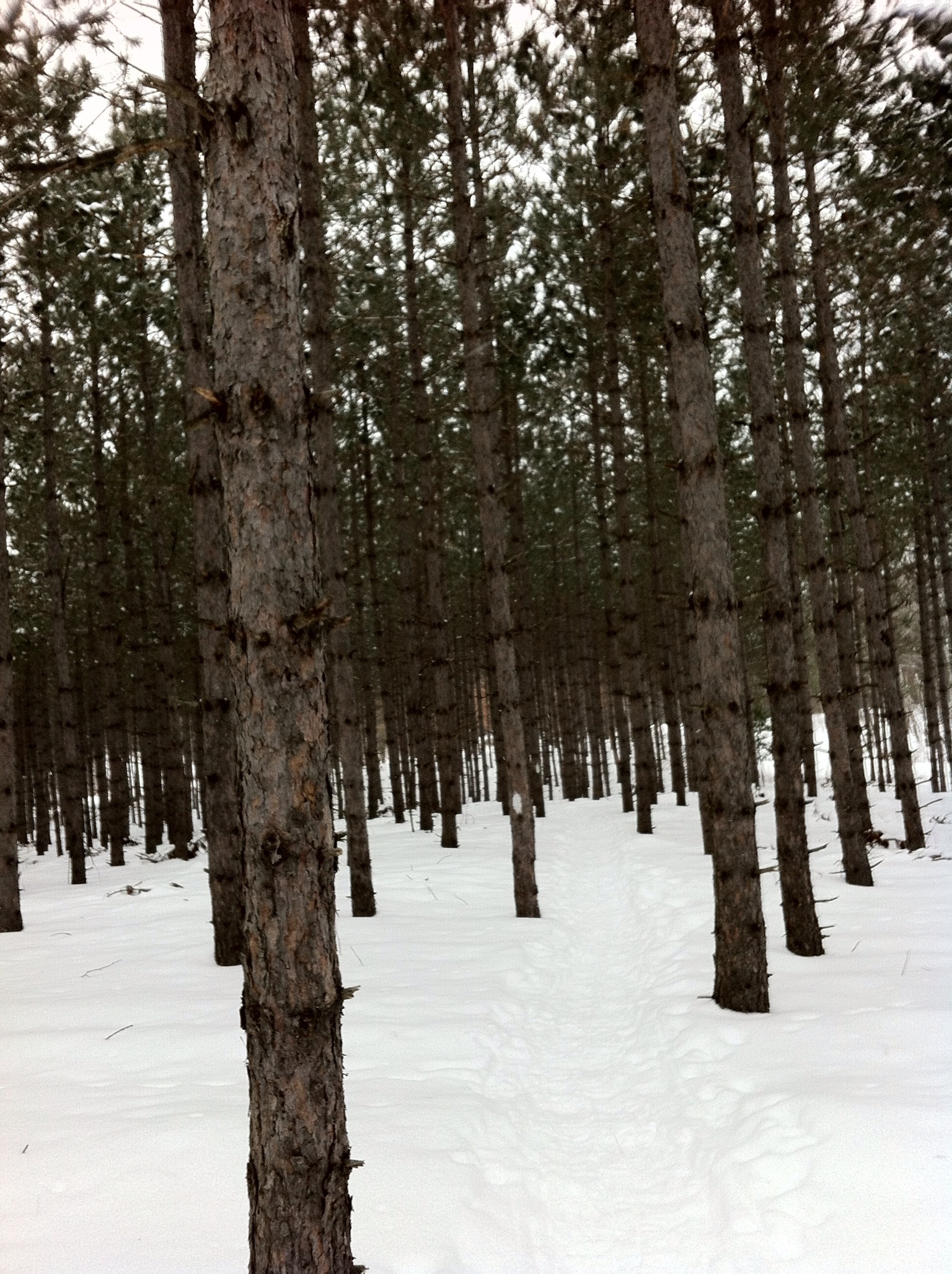
Those trees begged for a place in my novel, in a scene centered around the protagonist’s walk through northern pines, majestic in their own way and protective of whatever lies beyond.

Which, after two hours trudging along the winding and rolling and thick-with-powder path in snow shoes for the first time, this protagonist hoped was a warming house with hot cocoa and a masseuse.

Funny, how our minds wander.

What did you capture this weekend?

News & Noteworthy

The News.

Remember my post on Fearless Writing? I talked about taking chances, and not just on that work in progress. I know, I know. I keep bringing it up. But, mantras really work. Our efforts pay off, whether they nudge us in a different direction or shift our perspective ever so slightly or result in something much more concrete.

Suzannah Windsor, of Write It Sideways, is creating a new digital literary journal, COMPOSE. A while back, she sent out a call for editors, and I applied, not knowing if my experience was enough to earn me a spot on the masthead. But, I took the risk anyway. I was thrilled, then, to accept her offer of a position as an editorial assistant. Suzannah is a mother-writer who sets goals and gets them done. She’s a model for the rest of us trying to balance life and motherhood and writing, and I couldn’t be more excited to work with her on this new project. Read more about the full masthead here.

The Noteworthy.

At my day job recently, I heard of a website called Lynda.com. For half a second, I wondered about the site: who was this Lynda? What does she do? Then, I got busy with work again. It wasn’t until I saw a post on Facebook by Lisa Cron about her page on the site that I finally investigated. Lynda.com is an online learning center offering a myriad of courses from art and design to photography and, well, now writing. Lisa Cron, author of Wired for Story, has a new course up and running for those of us wanting to know more about story structure.

I’ve raved about Wired for story before, and I imagine the course follows Lisa’s book somewhat. But, if you’re like me, sometimes reading the book isn’t enough. I want more.

The course isn’t free. Not exactly. But, the cost is certainly doable: $25 gets you a 30-day subscription to lynda.com, which allows you to view Lisa Cron’s course AND any other courses that suit your fancy. Perhaps something on illustrations for a children’s book? One on formatting that ebook? Once you’ve subscribed, they’re all free. Even if you only watch Lisa’s The Craft of Story and cancel your membership after 30 days, that’s still a pretty good deal.

Another author using the internet as a classroom, of sorts, is Lisa Rivero. She’s written a great book for young historians called Oscar’s Gift, about Oscar Micheaux, the first major African-American filmmaker who has history as a homesteader as well. Right now, in honor of Black History Month, she’s posting lots of extras to go with her book: videos, writing prompts, and news about the time period in which Oscar lived. If you write historical fiction, for kids or grown-ups, check out Lisa’s website to see how historical resources can enhance the reading experience.

What’s new or noteworthy with you? And, have you ever visited lynda.com? I’d love to hear from someone who’s taken courses there, it looks so inviting.


Two Great Writing Books and a Prompt

Whatever kind of flash you write, fiction or non, the Rose Metal Press offers a book full of essays on craft and beautiful writing that will feed your creativity. I’ve mentioned the Field Guide to Writing Flash Nonfiction before: each time I open it, I bookmark pages and highlight and say yes, yes, yes.

Last Saturday, I met with my senior citizen friends for our creative writing class, and I read from Barbara Hurd’s essay in the Fieldguide, “Pauses:”

In music, a rest note can, by its command, make me lift my fingers. ‘Shh-and-shh,’ my piano teacher says as she counts out quarter-note rests, those squiggles on the score that look like weak-willed iron gates rethinking their prohibition to proceed. My hands hover over the keys; I listen as sound recedes; I’m poised and waiting. Yes, wait, I tell myself, out of habit; for inside such possibilities might be the world in abeyance, the music both gone and still here. . . . Wait. Linger. No need to rush.

Then, I presented the group with a prompt from Midge Raymond’s Everyday Writing that, in a way, corresponds with the idea suggested in Hurd’s essay:

Write about a time when something small – a chocolate bar, a smile from the right person at the right time, a martini – made you happy.

In other words, I asked them to write about a moment that caused them to take pause, to take note.

Around the table, one person read about the moment his two brothers, discharged from the war, saw each other for the first time in three years. Another person described the thrill, as a ten year old boy, of watching a man cut blocks of ice from atop his wagon, knowing he’d toss frozen chips to him and his friends waiting in the heat of the sun. I wrote about my son, how his pause in one moment filled my heart and stayed with me:

The life of a fifth grade boy is busy. With a flip of the light switch in the morning, the wheels are slow to start. But, once they get moving there is breakfast and the comics and where is the sports page and check the weather and do you know how cold it is in Fairbanks, Alaska? Can I wait in the car, Mom? I’m ready to go, I don’t want to be late for school, I don’t want to walk in with the first graders, can we go already? Mom!

I don’t move fast enough for my son. To add to the tension, his sister puts on her coat with such precision that we are always two minutes behind. By the time we reach school, my son has one hand on his backpack and one on the seatbelt release, and he is out the door and on the curb with barely a moment for me to say goodbye.

So it is especially important to note the day he jumped out of his seat, waved to me over his shoulder, and started to close the car door when he stopped. He turned back, then, and looked me in the eye. For a full second.

“Have a good day, Mom.”

Just like that.

He could have tossed the words over his shoulder, could have mumbled them under his breath. But he turned and looked at me, as if to be sure I was paying attention. To be sure.

Have a good day.

A simple and common farewell took on much more meaning in that second. It was puzzling and endearing, and I thought about it all day long.

These pauses in his day are rare, I know. So, I hold memories of them close; I sneak in my own unprompted affection in subtle ways: a pat on his knee, a kiss on the top of his head when he is deep into his morning cereal. And, when I can get away with it, I hold his hand; in the car, as I ask him about his day at school; on the couch, when I sit next to him briefly to see what show he and his sister are watching.

This holding of hands, it is usually fleeting. But he allows me that small gift, and it carries me.

When was the last time you were caught poised and waiting, and remembering? And, what happened?

Next month’s prompt (via Lisa Romeo’s Winter Writing Prompts Project): You look just like __________.