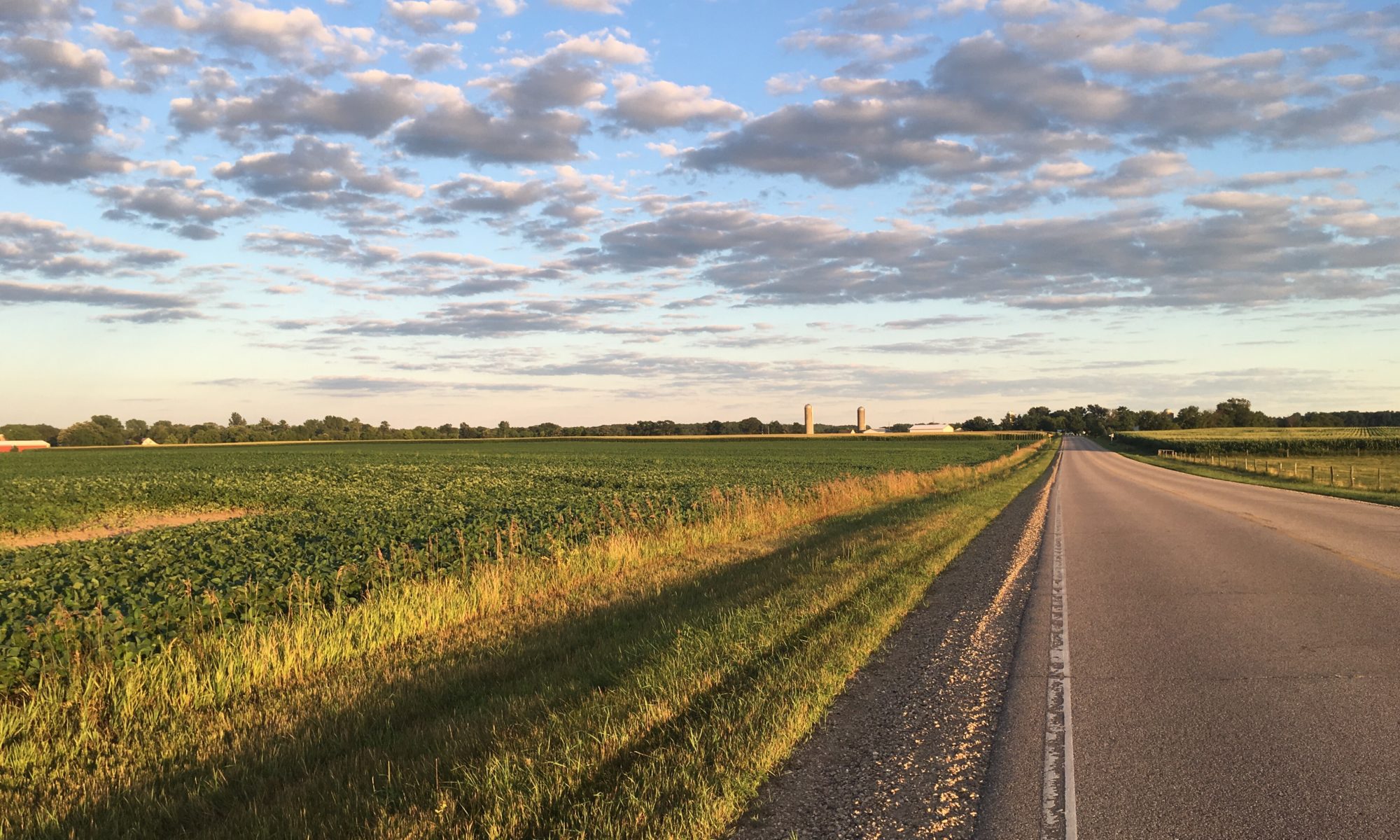
Last week I posted on writing prompts and putting pen to paper. Practice what you preach, they say. The Prompt: in the distance.

A swallow returns to its nesting place, a salmon returns to the mouth of the river, and she returns the same through waves of memory, back to the beginning. There is a place: a rooftop at midnight, an open window. She will take a blanket, step over the sash, her bare feet on shingles still warm from the heat of the day. She will say, Room for two, and he will follow, though the blanket is for her alone. She will take in the scent of wet grass, the glow of a crescent moon, the silhouette of trees marking a break in the horizon. She will breathe in the burn of his cigarette smoke as if it is the oxygen she needs and wonder at the comfort of him there. She will study the shape of her feet, the wear in his shoes. They will talk as strangers do, about nothing, about anything, until the mosquitoes drive them back inside. She will say something forgettable, but he will laugh true. Thank you for the smoke, he will tell her, then he will look her in the eye, keep a polite distance, smile. And leave. He will not ask for anything more. At this, she will be surprised and relieved. She will fall asleep to a sense of quiet she has not known for a long time. In the morning she will shed old skin; in a year she will move out, move on. But she will not forget: the open window, the silhouette, that simple moment in the distance when the tide shifted.
 On one hand, I see [prompts] as a critical component to the work. They serve as warm-ups in each of the classes I teach, as a way for participants to engage with the topic or lesson. Sometimes they work simply to get the ink in their pens flowing, to free the mind of anxiety before we dive into the real work. On the other hand, they can feel like torture. . . . But 9 times out of 10 prompts are working just as they should.
 Second, you’ll find me in the studio this Sunday, June 3rd, from 3-5pm (CST) facilitating another session of
  The idea of harmony is funny. Right off, I think of a sense of peace, a perfect blend. But there is complexity in the layers. I grew up the youngest in a family of five, and I have spent plenty of time reflecting on and searching for the harmony I always thought was lacking. . . . The truth is, though, that discord and differences mold us into a well-formed shape, individually and as a whole, and that shape, with its scratch of bitter and brush of sweet, is the essence of harmony. Yang Huang brings vision to this idea in her new collection of short stories, My Old Faithful, winner of the University of Massachusetts Press’s Juniper Prize.